30 October 2026
Major trends in global investment flows ahead of the World Investment Conference in Geneva (10-12 November).
Source: WIR 2026, UNCTAD
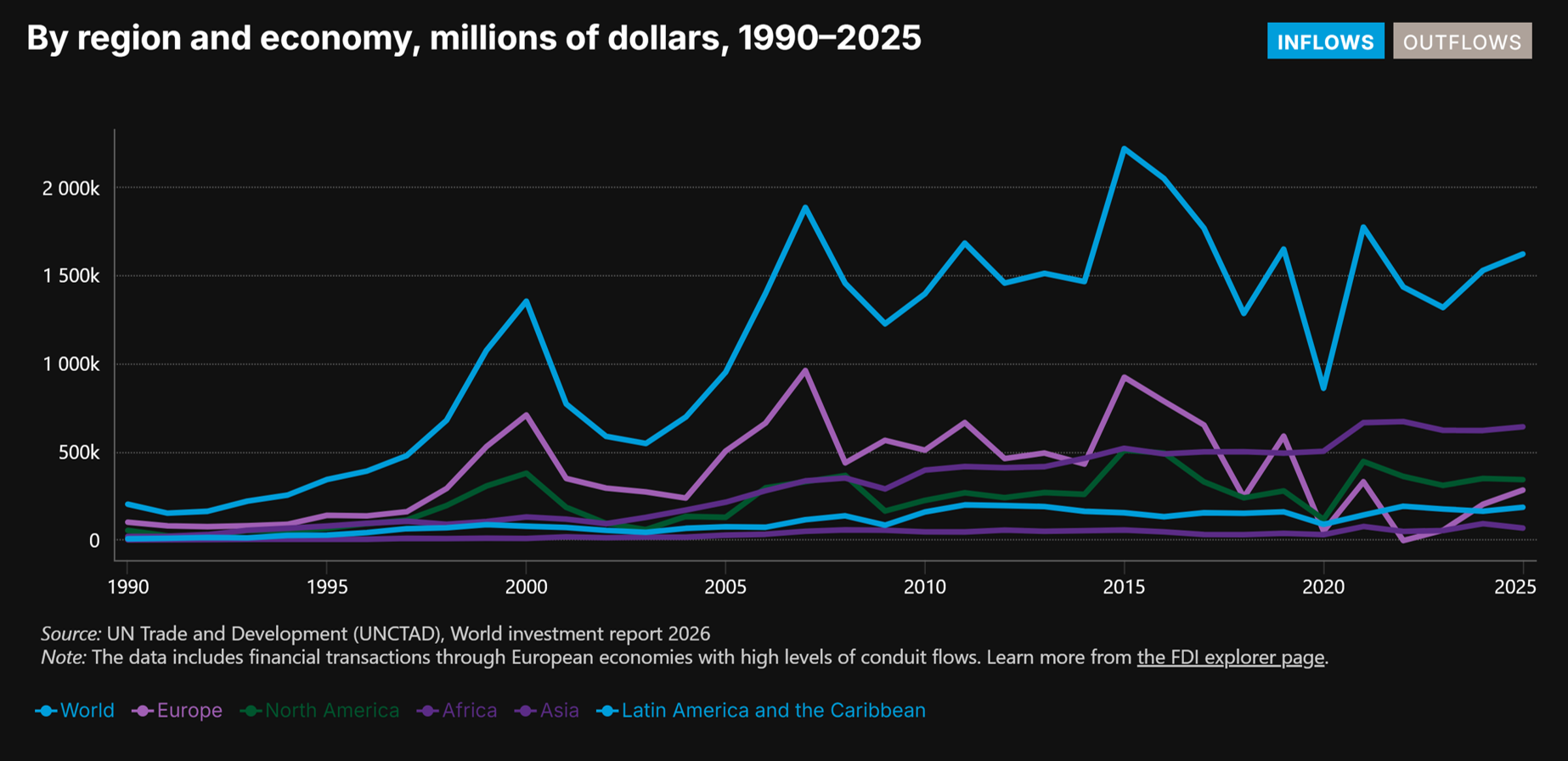
While reading the World Investment Report 2026 (UNCTAD), two key findings stood out. First, global foreign direct investment (FDI) has been slowly recovering, reaching 1.6 trillion USD in 2025. Yet this level stays far below its peak of 2.2 trillion USD a decade earlier. Second, investment remains highly concentrated: more than 80% of FDI flows were hosted by only 20 economies; and five strategic sectors (AI infrastructure, semiconductors, critical minerals, energy-transition technologies and other advanced technologies) accounted for 44% of announced greenfield investments in 2025.
Most of the time, we analyze FDI through the differentiation between developed and developing countries but I believe a regional perspective reveals another dimension of the story (see chart from FDI Explorer of UNCTAD).
Asia’s steadily rising FDI inflows over recent decades stand out. As the center of gravity of the global economy shifts towards Asia, the region’s investment trajectory raises an important question: could regional economic integration and interconnected development strengthen investment attractiveness and resilience to external shocks? This question invites us to look beyond individual countries and consider the regional conditions that influence investment decisions.
What, then, should countries consider when seeking to improve their competitiveness as investment destinations? Here is a brief strategic checklist:
Market access: Which markets and value chains can the country reach?
Infrastructure: Can transport, energy and digital systems support reliable, cost-effective operations?
Skills and innovation: Are the required talent, technology and supplier capabilities available?
Institutions: Are regulations predictable and administrative processes effective?
Strategic positioning: Does the country offer capabilities relevant to changing supply chains and emerging investment priorities?
This list could be a starting point for economies that struggle to attract investment. Regional cooperation can also help overcome limitations that individual countries may not easily resolve alone.
Recently, nearshoring and friendshoring have been the names of the game. Perhaps it is time to introduce ‘regionshoring’: strengthening regional cooperation, connectivity and complementary capabilities to make locations more attractive for investment.
Because competitiveness is not always a national game. Sometimes, the advantage (or the disadvantage!) lies in the region.