3. edition
12 February 2026
The EU’s trade deals and the World Bank's Human Capital Index Plus.
First, about the European Union’s competitiveness or rather lack of it. All projections point to a decline in the EU’s share in the global economy and trade for the coming years. In my opinion, this linear extrapolation may miss the up-and-coming European actions and communicated willingness to boost productivity, diversify resources and supply chains via new trading partners. What if we consider alternative pathways of stagnating or growing global share from the current 14% (in 2025).
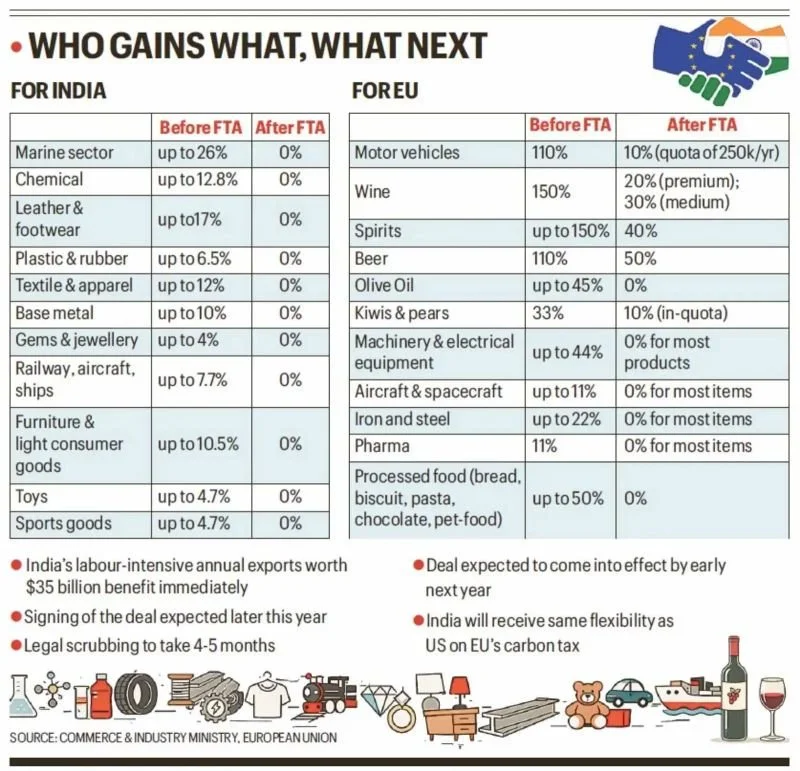
These scenarios can become reality by negotiating new trade deals and investment pacts, leveraging the EU’s market size and purchasing power of its almost half a billion population, and providing clear expectations with long-term commitments. Predictability, rules-based trustworthy partnerships will prove advantageous for the EU. In the past months, several trade deals were agreed or entered into force with Chile, the Mercosur, Indonesia, Singapore, South Korea, and most recently with India.
The EU-India free trade agreement alone with over 90% mutual tariff reductions will create a free trade area with 2 billion people and about 25% of the global GDP. The gradual reduction of tariffs could lead to gains for the capital-intensive industries in the EU, and for the labor-intensive manufacturing sectors and services in India. For strategic considerations, here are two questions:
1) How would you prepare for the upcoming flow of competitive goods at a cheaper price in the EU or goods of higher quality in India?
2) For supply chains and resource diversification, how to become the frontrunner when engaging new partners and suppliers?
Second, I attended the launch of the World Bank Group’s Human Capital Index Plus (HCI+), which comprehensively looks at the social interventions, contributions that have a profound economic effect. The report and the index quantitatively measure the impact of various social policies on human capital accumulation. It highlights case studies and well-functioning examples from local communities of integration and installed policy touch points on the path towards human capital accumulation. Investing in people is a must, but doing it the right way may need guidance. I find the place-based approach in human capital investment a promising novelty. This study proves its positive economic effects and is a great support for potential policy formulation and actions. It can be reached here: https://lnkd.in/epzTkHXj