4. edition
26 February 2026
Analysis of the International Monetary Fund’s latest review of the US economy.
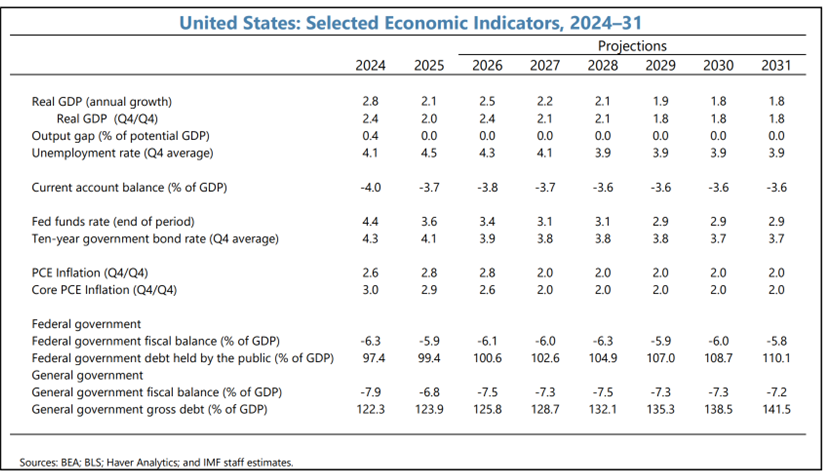
I find the IMF’s Article IV country review of the US economy a better source of information than President Trump’s State of the Union speech. It is a comprehensive overview of the macroeconomic fundamentals of the American economy, and I used it to make a SWOT analysis below from a strategic perspective.
Based on that, in my opinion, if the US does not seize those opportunities and turn to innovation, the threats could significantly reduce its competitiveness. The external imbalances and financial instability risks could prove to be a tough challenge to tackle but without doing so, investor trust might fade.
Strengths:
Economic growth is projected to increase from 2.2 to 2.4 per cent in 2026, mainly driven by productivity gains.
Inflation rate is expected at 2.2 per cent in 2026 and to remain around 2.0 per cent for the coming years, with tariff effects fading from early 2027.
Unemployment rate is expected to fall from 4.5 to 4.1 per cent in 2026, and to stay around 4 per cent, demonstrating the labor market being close to full employment.
Weaknesses:
The general fiscal deficit is expected to continuously exceed 7 per cent of GDP in the next few years.
The general government debt (debt to GDP ratio) is projected to gradually increase from 126 to 140 per cent of GDP by 2031.
The current account deficit is expected to remain around 4 per cent of GDP in the coming years.
The negative net international investment position (NIIP) is also expected to continue widening.
Opportunities:
Tax cuts and government spending could boost economic growth by about 0.75 per cent in 2026-27.
Deregulation and policies towards self-reliance, supply chain resilience and domestic production expansions could increase economic growth, spur investment and reduce foreign dependence.
Technology adoption could contribute to productivity gains.
Threats:
Tariffs cause a negative supply shock to the economy, with inflation risks increasing by around 0.5 per cent in the first half of 2026 and economic output decreasing by around 0.5 per cent. Similarly, diverse and uncertain economic policies could lower economic growth in the medium to long term.
Immigration policies and lower population growth could decrease the labor force in the medium to long term.
The growing government debt could further increase the financial stability risk of the country.
The external position of the economy is weaker than the internal fundamentals and could increase vulnerability.
You can find more details here.