8. edition
14 May 2026
Digital trends and solutions from the United Nations Virtual Worlds Days 2026.
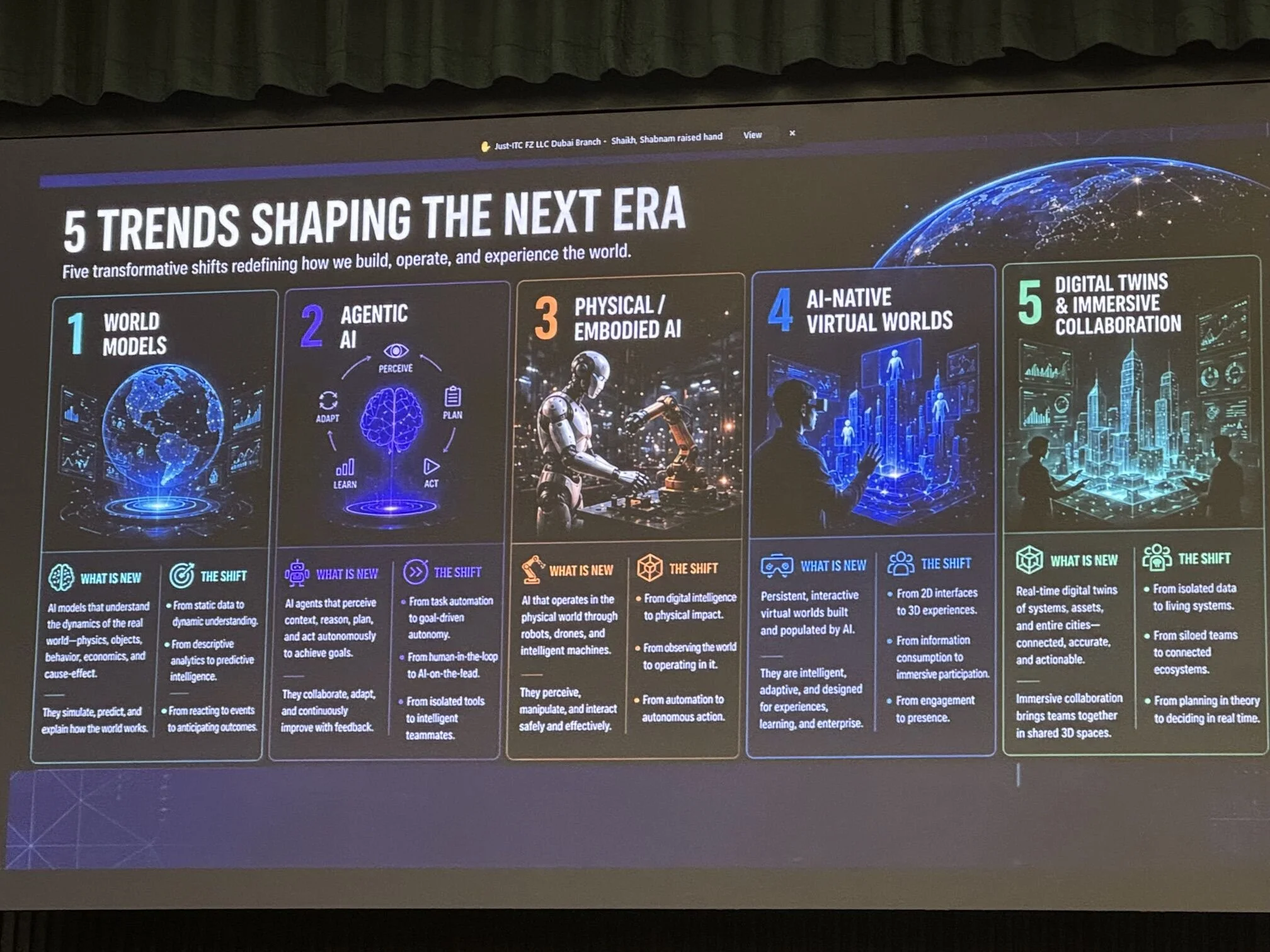
To start with trends and future outlook, I found the five trends shaping the next era meaningful. Here they are as shared by Dr Okan Geray:
World Models, a city-scale simulation, which can model traffic, economy, infrastructure and even citizen behavior, before actions are taken. It allows for testing decisions in advance.
Agentic AI, autonomous decision systems, which can plan, reason, and execute tasks independently across workflows and systems. It permits goal-driven autonomy.
Physical / Embodied AI, autonomous operations, which operates through robots, drones and intelligent machines in the physical world safely and efficiently. It creates autonomous action and operation beyond observations.
AI-native Virtual Worlds, living civic environments, where citizens, services and systems can interact persistently. It allows for immersive, interactive experiences and continuous engagement.
Digital twins + Immersive collaboration, real-time control systems, which can integrate IoT data, AI predictions and simulations into live digital replicas of city systems. It permits continuous and real-time optimization.
AI is here to lower the financial and institutional barriers to digital city solutions, enabling the move from idea to pilot and to impact much more quickly. The question remains whether we can build accelerated ecosystems in cities to capture the AI-enabled Citiverse opportunities.
Moreover, the high-level dialogue Toward the Citiverse showcased the realities and progress towards smart cities. We heard Valencia’s smart city experiences from the past 10-15 years, and how a major flooding became a catalyst for innovation to build a more people-centered Citiverse approach to strengthen resilience. In Hamburg, their digital twin has been evolving from data sharing into a decentralized modular system with real-time data modeling. Their open‑source city platform focuses on interoperability, citizen engagement, data storytelling, and remote sensing. Quelimane, heavily exposed to climate risks, has become one of the most cyclable and walkable cities globally. Their Data Resilience & Mobility Initiative includes the development of digital twins, climate resilience, smart mobility and infrastructure, and e‑governance. Rotterdam and its Citiverse places the focus on youth involvement, future skills, health, and education.
One point really stayed with me: there’s no one‑size‑fits‑all path to becoming a smart and resilient city. Being an advocate for specialized policy making, I agree that a shared language and common terminology help, but each city must develop according to its own characteristics and priorities.